Last Updated on November 19th, 2026 at 05:48 am
Quick answer
A prom dress is a formal or semi-formal dress worn to a school prom. Most are floor-length gowns, though knee-length and tea-length styles are also worn. When people ask what a prom dress “means”, they usually want to know what the term covers, what the style and fabric words mean, or what to wear. This guide explains all three.
What is a prom dress?
A prom is a formal end-of-school party, and in the UK it’s usually held at the end of Year 11 or Year 13. A prom dress is the outfit people wear to it. It’s a step up from everyday party wear, and for many people it’s the first time they choose a formal dress. Prom dresses are described by their style (the silhouette), fabric, neckline and length, and knowing these words makes shopping much easier.
Prom dress code
Most proms are formal or semi-formal. That usually means a floor-length gown, though a tea-length or knee-length dress is fine at many schools. Some schools set their own rules about hemlines, strap widths or necklines, so check your school’s guidance before you order. For more on what to avoid, see our guide to prom dress etiquette.
Prom dress styles explained
The style (or silhouette) is the shape of the dress. Here are the ones you’ll see most often.
A-line
Fitted at the waist, then flaring out gently towards the hem so the shape resembles a capital “A”. It suits many figures and is easy to move in.

Ball gown
The princess style: a fitted bodice, cinched waist and a full, voluminous floor-length skirt.

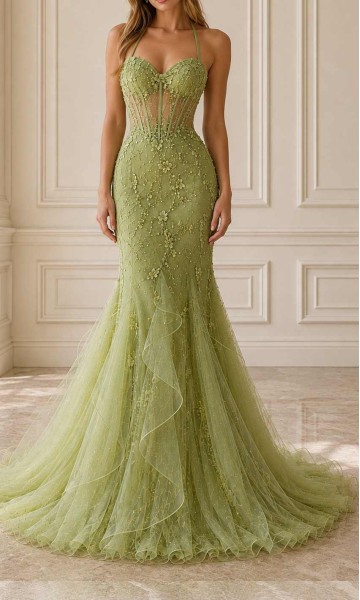
Mermaid
Fitted through the body from bodice to knee, then flaring out like a mermaid’s tail. It’s a dramatic, figure-hugging shape, and also comes in short lengths.
Browse our mermaid prom dresses.

Fit-and-flare
Fitted to the natural waist, then flaring out around the hips. It’s usually cut above the knee.
Sheath
Closely fitted from bodice to hem, with a sleek, straight line.

Bodycon
Short, snug and made from stretchy fabric, usually for parties and date nights.

Peplum
A fitted bodice with a short flared layer at the natural waist.

Two-piece
A separate top and skirt, usually with a bare midriff or a fitted waist. It’s a modern, fun alternative to a one-piece gown.

Shift
A straight, relaxed dress that skims the body. It’s casual, so for prom choose a shift dress with sequins or beading.
Looking for a longer dress? See our long prom dresses. To see how the necklines work, read our guide to the top 18 prom dress necklines.
Prom dress fabrics explained
The fabric changes how a dress looks and moves, and a few terms come up again and again.
| Fabric | What it is | Look and feel |
|---|---|---|
| Satin | A glossy weave, not a fibre | Smooth, shiny front, matte back |
| Silk | A natural fibre from silkworms | Soft, luxurious, light |
| Chiffon | A light, sheer fabric | Floaty and flowing |
| Tulle | A fine netted fabric | Airy, used for full skirts |
| Lace | An openwork fabric with patterns | Delicate and romantic |
| Velvet | A soft, dense fabric with a pile | Rich and warm |
What is a satin dress?
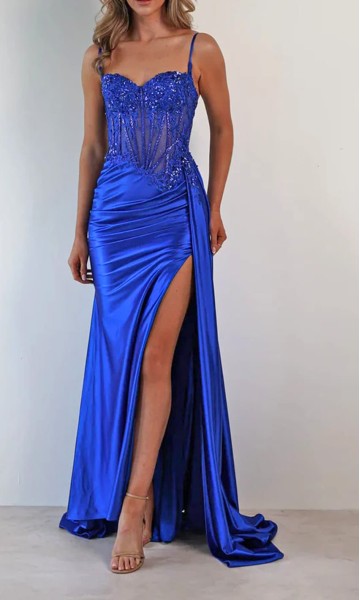
A satin dress is made from satin, a fabric with a glossy front and a dull back. Satin is a weave, not a fibre, so it can be made from silk, polyester or other fibres. Polyester satin is a common choice for prom dresses. Satin drapes smoothly and gives a polished, formal look. Lighter versions such as charmeuse flow softly, while heavier ones such as duchess satin hold their shape.
What does silk dress mean?
A silk dress is made from silk, a natural fibre produced by silkworms. Silk is soft and light, and it can be woven into satin, which is why the two words are often mixed up. So the difference is simple: silk is the fibre, and satin is the way the fabric is woven.
Check each product page for the fabric details before you order.
What does the 👗 emoji mean?
The 👗 emoji shows a dress. People use it for fashion, getting dressed up, parties, shopping and big nights out, so it’s a popular choice when talking about prom.
FAQ
A prom dress is a formal or semi-formal dress worn to a school prom. It’s usually floor-length, though shorter styles are also worn.
Formal or semi-formal. Check your school’s guidance, as some set rules about hemlines, straps and necklines.
No. Floor-length gowns are the most common, but tea-length and knee-length dresses are also worn, depending on your school.
A dress made from satin, a glossy weave that can be made from silk, polyester or other fibres.
No. Silk is a natural fibre. Satin is a weave that can be made from silk or from other fibres such as polyester.
It shows a dress and is used for fashion, parties and dressing up
Ready to find yours?
Browse our prom dresses or see our prom dresses 2027. Planning your timeline? Read our prom preparation timeline guide.
