
I still remember the moment my best friend called me, panicking, three weeks before her wedding. Her bridesmaid dress had arrived — and it wouldn’t zip up. Not even close. She’d ordered online, guessed her size based on what she normally wore at the mall, and the result was a $180 dress she couldn’t wear.
That phone call is basically why I wrote this guide.
Ordering bridesmaid dresses online is convenient, often more affordable, and gives you access to hundreds of styles you’d never find locally. But it comes with a real catch: sizing is all over the place. A size 8 at one retailer is not the same as a size 8 at another — and when you’re ordering for a group of women with different body types, the margin for error gets even smaller.
So let’s fix that. Here’s everything you need to know to take accurate bridesmaid dress measurements, choose the right size, and order custom dresses online — without a single tearful phone call afterward.
Why Standard Sizing Doesn’t Work for Bridesmaid Dresses
Before we get into the how-to, it helps to understand why this is such a common problem.
Formal Wear Runs Differently Than Everyday Clothes
Most ready-to-wear clothing is sized based on average proportions — the assumption being that your bust, waist, and hips fall within a predictable ratio. Formal wear doesn’t play by the same rules. Many bridesmaid dress brands size their gowns more like couture than casualwear. Going up one or two sizes from your everyday number is completely normal and nothing to stress about. What matters is the fit, not the tag.
The Bust-to-Hip Ratio Problem
Real bodies don’t follow a standardized ratio. You might have a larger bust with a narrower waist, or fuller hips but a smaller chest. When one measurement puts you at a size 12 and another puts you at a size 6, standard sizing simply breaks down — and a formal gown with a fitted bodice and structured skirt has almost no wiggle room to compensate.
Most reputable online bridal retailers now offer custom sizing or made-to-measure options, like Happyprom UK. When you use them correctly — with accurate measurements — they work remarkably well.

What You’ll Need Before You Start Measuring
Gather these before you do anything else:
- A soft fabric measuring tape (not a metal tape measure — it won’t flex with your body’s curves)
- A friend to help — measuring yourself, especially across the back, leads to inaccurate numbers
- Form-fitting undergarments, or the specific bra you plan to wear with the dress
- A pen and paper or your phone to write down every number as you go
- Bare feet — heels shift your posture and affect how a dress length falls
Avoid measuring over bulky clothing. Even a thin sweater can add an inch or two across the bust, which translates directly to a sizing error.
How to Take Bridesmaid Dress Measurements (Step by Step)
These are the six numbers you’ll need for almost every bridesmaid dress size chart online.
1. Bust Measurement
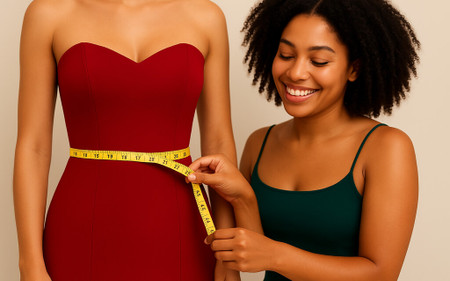
Wrap the measuring tape around the fullest part of your chest — usually across the nipples. Keep the tape parallel to the floor. It should be snug but not tight; you should be able to slip two fingers underneath. Don’t suck in or hold your breath.
Common mistake: Measuring too high (across the collarbone area) or too low (under the breast tissue). The fullest point is what you’re after.

2. Underbust / Ribcage
Measure directly under your breasts, where a bra band sits. Not every size chart asks for this, but it’s useful when you’re hovering between sizes. Keep the tape level all the way around.
3. Natural Waist
Your natural waist is the narrowest part of your torso — usually about an inch above your belly button. The easiest way to find it: bend to one side. The crease that forms is your natural waist. Measure there, and don’t hold it in. You want the real number.
Pro tip: For empire waist or A-line silhouettes, the natural waist measurement is more important than for a fitted sheath style. Know which silhouette you’re ordering.
4. Hips
Stand with your feet together and measure around the widest part of your hips and seat — typically 7 to 9 inches below your natural waist, but it varies by body type. Measure at a few spots and record the largest number.
Common mistake: Measuring at the hip bone instead of the fullest point of the seat. These are different spots, and the difference can be several inches.
5. Hollow-to-Hem (the One Most People Skip)
This is the measurement most brides forget to take, and it’s one of the biggest reasons online dress orders end up the wrong length.
The “hollow” is the small dip at the base of your throat — right between your collarbones. Stand up straight on a hard floor with bare feet, and have your friend measure straight down from that point to wherever you want the hem to fall (floor, ankle, knee, etc.).
If you plan to wear heels on the wedding day, put them on before taking this measurement. Even a two-inch heel changes the hem length you’ll need.

6. Shoulder Width
Measure from the outer edge of one shoulder to the outer edge of the other, across the back. This matters most for off-the-shoulder, cold-shoulder, and thicker strap designs. If you’re ordering a style with delicate spaghetti straps, the shoulder width measurement matters less — but it never hurts to have it.
How to Record Your Measurements (Free Template)
Write everything down in both inches and centimeters — size charts vary by brand and country of origin, and you don’t want to be converting at checkout.
| Measurement | Inches | Centimeters |
|---|---|---|
| Bust | _______ | _______ |
| Underbust | _______ | _______ |
| Natural Waist | _______ | _______ |
| Hips | _______ | _______ |
| Hollow-to-Hem | _______ | _______ |
| Shoulder Width | _______ | _______ |
Re-measure at least once before you finalize your numbers. A single inch difference in the bust can mean a full size jump in a formal gown. Getting it right here saves you everything downstream.
How to Read a Bridesmaid Dress Size Chart
Having your measurements is only half the job. Using the size chart correctly is the other half.
Don’t just glance at the chart and match your bust — actually sit with it.
Step 1: Check all three measurements, not just one. Size charts show ranges for bust, waist, and hips. Compare all three against your numbers. If your bust falls in a size 10 range but your hips fall in a size 14 range, you have a fit challenge that needs a deliberate decision.
Step 2: When in doubt, size up. A dress that runs slightly large can be altered down. A dress that’s too small usually can’t be let out — formal wear often has minimal seam allowance. Tailoring a size down is almost always easier and cheaper than trying to add fabric.
Step 3: Read the brand’s specific notes. Many retailers include language like “this style runs small in the bust” or “we recommend sizing up for curvier figures.” These notes come from real customer feedback. Don’t skip them.
Step 4: Ask about seam allowance. If you’re ordering custom or made-to-measure, check whether the brand builds in extra seam allowance. Many quality brands add an inch or two as a buffer — this gives you flexibility if measurements shift between ordering and the wedding.
What to Do When Your Measurements Don’t Match One Size
Pick the size that fits your largest measurement, then have it tailored down where needed. Taking in extra fabric is much more straightforward than adding it. Most experienced seamstresses can bring in a bodice, nip a waist, or adjust a back closure without any issues.
Custom Sizing vs. Standard Sizing: Which Is Right for You?
Most online bridesmaid dress retailers offer both options, and choosing the right one upfront saves a lot of headaches.
When to Choose Standard Sizing
Standard sizing (preset categories like 0, 2, 4, 6, etc.) is faster, often slightly cheaper, and works well when your bust, waist, and hip measurements all land comfortably within the same size range on the brand’s chart. If your numbers are consistent, go standard.
When to Choose Custom / Made-to-Measure
Custom sizing lets you input your exact measurements, and the dress is cut specifically for your body. It typically adds £20–£50 (good news: more and more online retailer offer free custom made service now )to the price and extends lead time to 4–6 weeks instead of 2–3. But if your measurements land in different size ranges across bust, waist, and hips — go custom. The extra cost is significantly less than emergency alterations under a deadline.
My honest recommendation: have every bridesmaid check her numbers against the size chart. Anyone who finds herself straddling two different sizes should order custom. The cost difference is minor. The stress difference is not.
Tips for Ordering Bridesmaid Dresses as a Group
Timing: How Far in Advance Should You Order?
- Standard sizing: Order at least 3–4 months before the wedding
- Custom sizing: Order at least 5–6 months out
- International retailers: Add 2–4 weeks for shipping and potential customs delays
Rush orders are available at most retailers, but they add cost and create stress you genuinely don’t need. Build in extra time — weddings have a way of moving faster than you expect.
Who Should Coordinate the Orders?
Designate one person — usually the maid of honor or the bride — to collect every bridesmaid’s measurements and compare them to the size chart before any orders are placed. This keeps sizing decisions consistent, catches errors before checkout, and ensures everyone is ordering from the same retailer.
Use the same retailer for everyone. Mixing brands creates subtle differences in dye lots, fabric sheen, and silhouette that will show up in photos. Most brands accommodate a wide range of sizes, so there’s rarely a reason to split the order.
Budget for alterations. Even with accurate measurements and custom sizing, most bridesmaids need minor alterations — a hem adjustment, a waist nip. Build £50–£150 per person into your budget upfront rather than discovering it later.

Online Shopping Red Flags to Avoid
Not every online bridesmaid dress retailer is equally reliable. Watch for these warning signs:
- No size chart, or one with very wide ranges. A chart that lumps sizes 4–8 together as “small” won’t give you enough precision for a formal gown.
- No return or exchange policy. Custom dresses are typically non-returnable (reasonable, since they were made for you), but standard sizes should have some exchange or alteration credit option.
- Reviews mentioning inconsistent sizing. Multiple reviews saying “runs very small” or “nothing like the size chart” are a real warning — not an outlier.
- Prices that seem implausibly low. A $30 bridesmaid gown is almost never what it appears to be in the photos. Mid-range retailers in the $80–$200 range with several years of established history tend to be the reliable sweet spot.
What to Do If the Dress Arrives and Doesn’t Fit
Even with careful measurements, it sometimes happens. Stay calm — there are options.
Step 1: Don’t remove tags or alter anything before assessing. You’ll need the dress in original condition to work with the retailer.
Step 2: Contact the retailer immediately. Most have a 3–7 day window after delivery to report fit issues. Document the problem with clear photos showing exactly where the fit is off.
Step 3: Get a quote from a local tailor. A skilled seamstress can do more than most people expect — letting out seams, adjusting the back closure, reshaping a bodice, shortening a hem. Get the quote before assuming the dress is unwearable.
Step 4: If the wedding is soon, consider renting. Several bridesmaid-focused rental services now offer a wide range of styles and sizes. If a replacement dress needs to be ordered, you may not have time to wait for it — renting a similar style in the right size can save the day.
Bridesmaid Dress Measurement Checklist (Print or Save This)
Before you hit “place order,” confirm every item:
- Used a soft fabric measuring tape (not metal) ( )
- Measured in form-fitting undergarments, not bulky clothes ( )
- Had a second person take the measurements ( )
- Recorded bust, underbust, waist, hips, hollow-to-hem, and shoulder width ( )
- Compared all measurements (not just bust) to the brand’s size chart ( )
- Read the brand’s specific sizing notes for the style selected ( )
- Chose custom sizing if any two measurements land in different size ranges ( )
- Confirmed order lead time works within the wedding timeline ( )
- Reviewed the return, exchange, or alteration policy ( )
Final Thoughts
Ordering custom bridesmaid dresses online doesn’t have to be stressful. The real secret isn’t finding a perfect brand or a lucky fit — it’s spending 20 extra minutes with a fabric tape measure and actually using the information a size chart gives you.
Have a bridesmaid dress sizing question? Drop it in the comments below — happy to help troubleshoot.
