


Why This Question Who Pay for What in a Wedding Party Comes Up So Often
Almost nobody sits down and explains wedding party finances from the start — everyone just assumes everyone else already knows the “rules.” The problem is, those rules were written decades ago, they vary by region and family, and in practice, they get bent, ignored, or renegotiated in nearly every wedding. That gap between “tradition” and “what actually happens” is exactly where awkward conversations, hurt feelings, and unexpected bills come from.
If you’re planning a wedding — or standing in one — and you’re not sure who’s supposed to cover what, you’re not alone, and you’re not being difficult by asking. Money clarity early on is one of the kindest things a couple can offer their wedding party, and one of the smartest things a bridesmaid or groomsman can ask for before agreeing to a role.
Here’s the full breakdown, traditional expectation versus modern reality, so you can set expectations that actually work for your group.
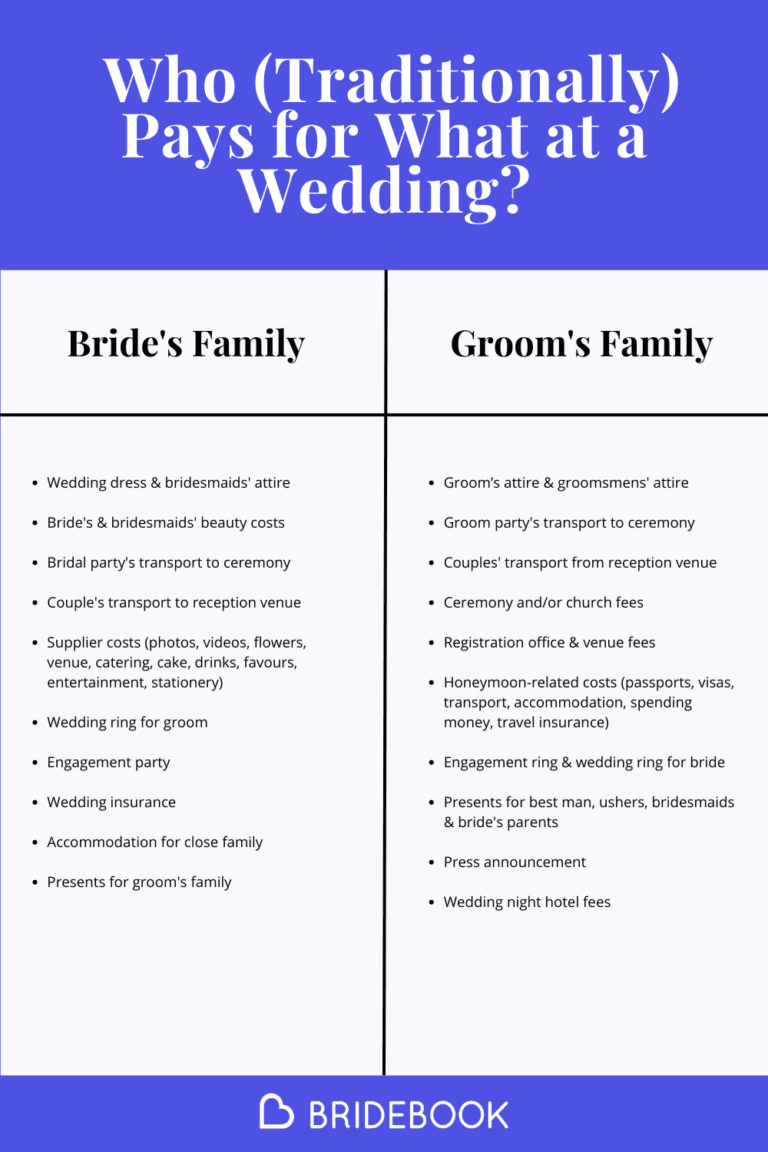
Quick Answer: The Traditional UK Wedding Party Expense Breakdown
At a glance, here’s how costs have traditionally been divided in UK weddings:
- The couple generally covers:
- bridesmaid and groomsmen gifts
- the rehearsal dinner (often the groom’s family, if one is held)
- wedding party hair and makeup on the day (increasingly common)
- and any specific accessories they’ve requested (like matching jewellery).
- Bridesmaids and groomsmen generally cover:
- their own attire (dress or suit)
- travel to the wedding
- a contribution to the hen do or stag do
- and a wedding gift.
That said, “traditional” is doing a lot of heavy lifting in that sentence — plenty of modern couples split costs differently, and there’s no rule that says you have to follow the old playbook. Let’s break it down role by role.
What Bridesmaids Typically Pay For
- Their own bridesmaid dress — usually the single biggest expense, typically £70–£200 depending on style and retailer.
- Shoes and accessories — unless the bride has specified and provided them.
- Hair and makeup on the wedding day — this is shifting; more couples are covering this cost to keep the look cohesive, but it’s still commonly billed to the bridesmaid.
- Travel and accommodation — for the wedding itself, plus any additional trips like dress fittings or the hen do.
- A contribution to the hen do — often split among the whole party, sometimes fronted by the maid of honour and divided afterwards.
- A wedding gift — separate from the above, and generally expected regardless of what else they’ve paid for.
What Groomsmen Typically Pay For
- Their suit or morning wear hire/purchase, including any accessories like ties or pocket squares specified by the groom.
- Travel and accommodation.
- A contribution to the stag do.
- A wedding gift.
Groomsmen expenses tend to run lower than bridesmaid expenses overall, mostly because suit hire is common in the UK and less variable in cost than a bridesmaid dress bought new.
What the Couple Typically Pays For
- Wedding party gifts — a thank-you gift for each bridesmaid and groomsman is a near-universal expectation, regardless of what else is split.
- The rehearsal dinner, if the couple chooses to have one — though where it happens, it’s traditionally covered by the groom’s family rather than the couple directly.
- Bouquets and buttonholes for the wedding party.
- Any specific “matching” requests — if the couple wants a very particular shoe, jewellery piece, or accessory, etiquette says the couple covers that add-on cost, since it’s beyond a normal dress code ask.
- Transport on the wedding day itself, if arranged as a group (like a car or minibus to the venue).
Comparison Table: Traditional vs. Modern Approach of Who Pay for What in A Wedding
| Expense | Traditional Expectation | Increasingly Common Modern Approach |
|---|---|---|
| Bridesmaid dress | Bridesmaid pays | Bride offers a price range or subsidises part of the cost |
| Groomsman suit | Groomsman pays (often hires) | Same, though some grooms now cover hire fees |
| Hair & makeup | Bridesmaid pays | Bride covers this to keep a uniform look |
| Hen do / stag do | Wedding party pays their own way | Couple or organiser sets a firm budget cap to avoid pricing anyone out |
| Wedding day travel | Individual pays | Individual pays (largely unchanged) |
| Wedding party gifts | Couple pays | Couple pays (largely unchanged) |
| Hen/stag do contribution | Split among wedding party | Split, but often with a suggested cap communicated in advance |
When Costs Get Complicated: A Few Common Scenarios
A bridesmaid can’t afford the dress
This is common enough that it deserves its own conversation — we cover exactly how to handle it with empathy and real solutions in Bridesmaid Refuses to Buy the Dress? How to Handle Cost Conflicts.
The hen do is priced out of reach for some of the party
This is one of the most common sources of quiet resentment in a wedding party, especially with the rise of multi-day trips abroad. If you’re the maid of honour or bride, it’s worth proposing a lower-cost UK-based alternative alongside any trip away, so no one has to choose between their budget and feeling included.
A groomsman is asked to buy a suit he’ll never wear again
Hiring is the modern default for exactly this reason, and it’s worth normalising as the group’s first option rather than the fallback.
One family wants a much bigger wedding party than the couple can afford to gift and feed
This is a couple-side budgeting issue more than a wedding-party one, but it’s worth mentioning: a smaller, well-supported wedding party is often kinder to everyone’s wallet than a large one stretched thin.
What About the Couple’s Own Big-Ticket Costs?
Wedding party expenses are only one piece of the puzzle — a lot of people searching “who pays for what in a UK wedding” are really asking about the couple’s own costs, so it’s worth covering those traditional splits too.
Who pays for the wedding rings?
Traditionally, each partner buys the other’s wedding ring. The groom is customarily expected to buy the bride’s ring, and the bride buys the groom’s — though these days it’s just as common for couples to buy both rings together out of a shared budget, particularly if they’re also splitting the rest of the wedding costs jointly.
Who pays for the wedding dress?
Traditionally in the UK, the bride (or her family) pays for the wedding dress, separately from the rest of the wedding budget. This is one of the more enduring traditions, though many modern couples now fold it into a combined wedding pot rather than treating it as the bride’s family’s sole responsibility.
Who pays for the wedding reception?
This is traditionally the biggest cost of the whole day, and historically it fell to the bride’s family. In practice, UK couples now split reception costs in all sorts of ways — some split it evenly with their own families, some cover it entirely themselves, and some have both families contribute a set amount towards the venue and catering. There’s no longer a single “correct” answer, but it’s worth agreeing early who’s contributing what, since the reception is usually where the bulk of the budget goes.
Who pays for the groomsmen’s suits in the UK?
As covered earlier, groomsmen traditionally pay for their own suit hire or purchase, along with any accessories the groom has asked them to match (ties, waistcoats, pocket squares). Some grooms choose to cover the hire fee themselves as a thank-you, but it’s not the default expectation.
How to Set Expectations Early (So Nobody’s Surprised)
The single best fix for wedding party money stress is simple: say the numbers out loud, early. Specifically:
- Share a realistic price range for the dress or suit before anyone shops.
- Give an estimated total cost of being in the wedding party — dress/suit, travel, hen/stag do, gift — so people can decide with real information.
- Set a budget cap for any group trip, and stick to it even if some members would spend more individually.
- Be explicit about what you, as the couple, are covering versus what you’re asking your wedding party to cover.
This kind of transparency doesn’t just prevent hurt feelings — it also means the people who say yes to being in your wedding party are saying yes with full information, which makes the “yes” mean more.
Who Pay for What in A Wedding UK Frequently Asked Questions
No — traditionally, bridesmaids cover their own dresses. However, many modern brides choose to cover part or all of the cost, especially if they’ve picked an expensive style or want to ease financial pressure on their wedding party.
This varies. Traditionally it’s the bridesmaid’s own expense, but it’s increasingly common for the bride to cover hair and makeup for her wedding party to ensure a consistent look for photos.
No — it’s the long-standing norm in the UK and most people expect it. What matters is communicating the expected cost range clearly before anyone commits, so there are no surprises later.
Typically, the wedding party covers their own costs for a hen do or stag do, often organised and sometimes partly funded by the maid of honour or best man. Setting a clear budget cap in advance helps make sure the trip stays inclusive.
Estimates vary, but between the dress, shoes, travel, hen do contribution, and gift, total bridesmaid costs commonly fall between £400 and £1,000, depending on how many events are involved and how far the wedding requires travelling.
Traditionally, each partner buys their future spouse’s wedding ring — the groom buys the bride’s, and vice versa. Many modern couples now buy both rings together from a shared budget instead.
Traditionally, the bride or her family covers the cost of the wedding dress, separately from the rest of the wedding budget. Increasingly, couples treat it as part of a combined pot rather than a cost the bride’s family covers alone.
Historically, the bride’s family paid for the reception, as it’s usually the single largest expense of the day. Today, UK couples handle it in a range of ways — splitting it with both families, covering it entirely themselves, or agreeing a set contribution from each side in advance.
Groomsmen traditionally cover the cost of hiring or buying their own suit, plus any matching accessories the groom requests. Some grooms offer to cover the hire cost as a gesture, but it isn’t the standard expectation.
Ready to Find a Dress That Works for Every Budget?
However you decide to split costs, the easiest place to start is with a dress your whole bridal party can actually afford. Browse bridesmaid dresses across a range of prices in coordinating colours, so every bridesmaid finds an option that fits her budget and your vision for the day.
[Shop Affordable Bridesmaid Dresses UK →]
People Also Interested in:
Real UK Bridesmaid Dress Prices by Budget
How Much Does It Cost to Be a Bridesmaid? (UK Breakdown)
How to Set a Bridesmaid Dress Budget Before You Shop (UK Guide)
Bridesmaid Dress Etiquette: Who Pays and How to Choose (UK Guide)
